|
Deep Slow Breathing helps in Dementia and Alzheimer’s Disease Shiv Talwar, Founder, Spiritual Heritage Education Network, Waterloo, Ontario, Canada Introduction
Recently, we came across convincing research showing how conscious, deep, slow breathing, mindfulness, and breath-based interventions can improve blood biomarkers of cognitive function in our aging communities and markedly slow the rate of decline in patients with dementia and Alzheimer’s disease. This technical note reports on that research. SHEN long realized the importance of DSB, deep, slow breathing as a readily available tool for conscious, intentional living. It invested in developing a web app called Taking Life Off Autopilot to teach, learn, and practice DSB, which runs on any device with internet access. You can access this app by clicking here. Foundational Research
Deep Breathing & Cognitive Performance in Older Adults
• Deep and slow breathing (DSB) significantly enhances learning, memory retention, attention, working memory, and spatial perception in the elderly—an at-risk population for dementia. In a randomized study, participants who performed DSB before or after learning sessions showed greater cognitive improvements compared to controls (Park and Song 2023), (Lee, Park and Song 2023). Autonomic Regulation, Amyloid Clearance & Alzheimer’s Biomarkers
• A controlled breathing regimen (inhale–exhale cycles of 5 seconds, 20 min twice daily for four weeks) increased heart rate variability—an indicator of parasympathetic activation—and reduced blood levels of amyloid-β peptides, implicated in Alzheimer’s pathology (Abramson 2024), (Min et al. 2023) and (Min et al. 2025). Systematic Reviews of Breathing Interventions
• A 2025 systematic review (10 studies) confirmed that breathing exercises improve overall cognition and memory recall, with additive benefits when combined with physical activity (Rao and Khan 2025). Pranayama & Mental Health: Relevance to Cognitive Well-being
Summary of Evidence
These converging lines of evidence—from randomized trials, meta-analyses, and biomarker research—underscore the promise of deep breathing and breath-based mindfulness practices for maintaining cognitive health and potentially mitigating early dementia processes. Biological Mechanisms
Amyloid-Beta is a critical peptide involved in the pathology of Alzheimer's disease. Its accumulation in the brain leads to the formation of amyloid plaques, which are toxic to neurons and contribute to cognitive decline. Here’s what current research reveals about the impact of deep or paced breathing on amyloid β levels: Impact on Plasma Amyloid-β
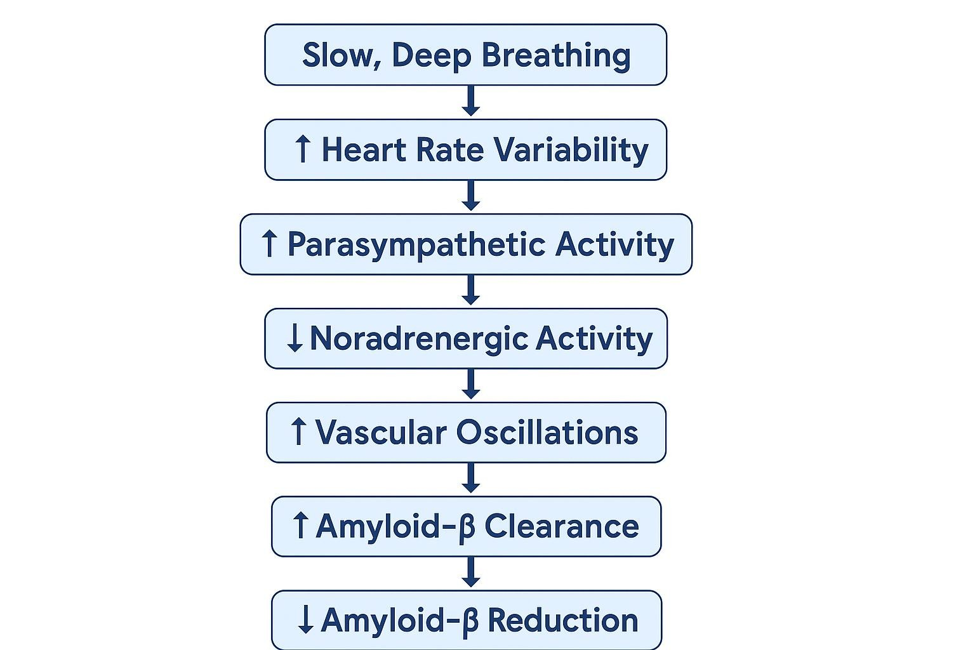
o It stimulates parasympathetic-mediated noradrenergic suppression o Promotes endothelial–platelet interactions, impacting amyloid-β production and clearance A mechanistic study in Innovation in Aging showed that high-amplitude heart-rate oscillations increased p-selectin (a marker of endothelial activity) and correlated with decreased plasma Aβ levels, suggesting improved vascular-mediated clearance (Min 2023), (Jungwon, et al. 2023). Comparable to Sleep-Like Clearance
Summary of Biological Mechanisms
Deep or paced breathing influences amyloid-β dynamics by:
This non-pharmacological approach reduced circulating Aβ40/42 in healthy adults over just four weeks—a promising foundation for further Alzheimer’s prevention strategies. Step-by-step physiological Pathway
. Slow, Deep Breathing Initiation • Breathing at ~5–6 breaths per minute (e.g., 5 sec inhale, 5 sec exhale) activates baroreflex and respiratory sinus arrhythmia, creating large oscillations in heart rate.
Summary Flow
Deep Breathing → HRV ↑ → Parasympathetic Tone ↑ → Noradrenaline ↓ → Sleep-like Clearance ↑ + Vascular Oscillations ↑ → Amyloid-β Clearance ↑ → Plasma Aβ ↓
Concluding Remarks
References
Abramson, Ashley. 2024. "Psychology is improving brain health and aging". American Psychological Association, January. https://www.apa.orBramsong/monitor/2024/01/trends-brain-health-aging&nb…; 2020. Cognitive Training and Breath Exercises for Mild Cognitive Impairment. https://www.alzheimers.gov/clinical-trials/cognitive-training-and-breat…. Dolan, Eric W. 2023. "Breathing exercises show potential in modulating Alzheimer’s biomarkers, study finds." PsyPost. https://www.psypost.org/breathing-exercisesshow-potential-in-modulating…. Jungwon, Min, Jeremy Rouanet, Alessandra Cadete Martini, Kaoru Nashiro, and Hyun Joo Yoo. 2023. "Modulating heart rate oscillation affects plasma amyloid beta and tau levels in younger and older adults." Scientific Reports. Accessed December 2025. https://doi.org/10.1038/s41598-023-30167-0. Lee, Su-Ha, Dae-Sung Park, and Chang-Ho Song. 2023. "The Effect of Deep and Slow Breathing on Retention and Cognitive Function in the Elderly Population." Healthcare 111 (6). https://doi.org/10.1007/978-3-031-85908-3_4410.3390/healthcare11060896. Min, J., Rouanet, J., Martini, A. C., Nashiro, K., Yoo, H. J., Porat, S., Cho, C., Wan, J., Cole, S. W., Head, E., Nation, D. A., Thayer, J. F., & Mather, M. (2023). Modulating heart rate oscillation affects plasma amyloid beta and tau levels in younger and older adults. Scientific Reports, 13(1), 3967. https://doi.org/10.1038/s41598-023-30167-0 Min, J., Rouanet, J., Cole, S., Nashiro, K., Yoo, H. J., Cho, C., Head, E., & Mather, M. 2023. "POTENTIAL MECHANISMS THROUGH WHICH INDUCING HEART RATE OSCILLATIONS AFFECTS PLASMA AMYLOID BETA LEVELS." Innovation in Aging 7(Supplemental_1) (68). Accessed December 22, 2025. doi:10.1093/geroni/igad104.0219. Mirabito, Geazia, and Paul Verhaeghen. 2023. "The Effects of Mindfulness Interventions on Older Adults’ Cognition: A Meta-Analysis." The Journals of Gerontology, March 3. https://doi.org/10.1093/geronb/gbac143. Mütze, Christian, Dietmar Mitzinger, and Heidemarie Haller. 2025. "Effectiveness of pranayama for mental disorders: a systematic review and meta-analysis of randomized controlled trials." Front. Psychiatr, August 13. https://doi.org/10.3389/fpsyt.2025.1616996. Park, Dae-Sung, and Chang-Ho Song. 2023. "he Effect of Deep and Slow Breathing on Retention and Cognitive Function in the Elderly Population." Healthcare.Https://doi.org/10.3390/healthcare11060896. Rao, s, and A Khan. 2025. "Effects of Breathing Exercises on Cognition: A PRISMA Guided Systematic Review. https://doi.org//10.1007/978-3-031-85908-3_44. Shi, Jiaxin, Hao Tian, Jingwen Wei, Wenhan Xu, Qin Luo, and Jin Peng. 202https://doi.org/10.1007/978-3-031-85908-3_445. "Meditation for subjective cognitive decline, mild cognitive impairment and Alzheimer’s disease: a systematic review and meta-analysis of randomized controlled trials." Front. Public Health, May 29. https://doi.org/10.3389/fpubh.2025.1524898. |