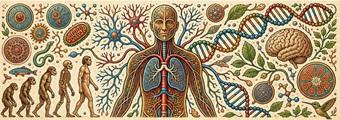
We are biological beings. To understand what makes us tick, we must understand our biology. Only then will we fully understand our groundbreaking and revolutionary Neurobiology of Transformation educational initiative.

We are biological beings. To understand what makes us tick, we must understand our biology. Only then will we fully understand our groundbreaking and revolutionary Neurobiology of Transformation educational initiative.

Transformation is not only a spiritual idea, but a scalable biological capacity. The breath connects the body, brain, mind, and behaviour.
This is the foundation of Neurobiology of Transformation: transformation becomes possible when we understand the living unity of brain, body, breath, and behaviour.
Unregulated movements of the body, brain, breath, or behaviour underlie o unregulated biology with ordinary states of physical health, mental health, and social connection.
Regulate the movements of your body, brain, breath and behaviour to self-regulate your biology. A self-regulated human being is the beginning of a peaceful world, living in health and harmony.
The breath is not just air moving in and out. It is a biological lever. Through the breath, we influence the body, the brain, attention, emotion, and behaviour.
Conflict is not only ideological. It is also biological. A dysregulated human being cannot easily create a peaceful society. If we want peace between identities, we must first teach regulation within the human being.
Conflict begins inside the human body—in the nervous system, in stress physiology, in patterns of reaction.
When the body is dysregulated, the mind becomes reactive. Attention narrows. Fear increases. We stop seeing the whole person in front of us.
The Neurobiology of Transformation teaches how inner regulation can become the foundation for outer harmony.
What you focus on becomes what your brain rewires. Attention acts like a spotlight that tells the brain which circuits to strengthen.
Your autonomic state (calm vs. stressed) determines which parts of the brain dominate — the prefrontal cortex for clarity and learning, or the amygdala for survival. Calm states make rewiring easier; stressed states reinforce defensive patterns.
Strong emotional states release neuromodulators (like dopamine and norepinephrine) that make the brain more “imprintable,” reinforcing whatever pattern is active in that moment.
Learning unfamiliar skills or shifting long‑held habits forces the brain to build fresh neural networks, literally changing its structure and function.
Neuroplasticity allows neurons to form new connections and strengthen or weaken existing ones throughout life. This means your brain is constantly being remodeled by experience, attention, and repetition.
Every time you think a thought, feel an emotion, or perform an action, the associated neural circuits fire — and repeated firing strengthens those circuits, making patterns more automatic.